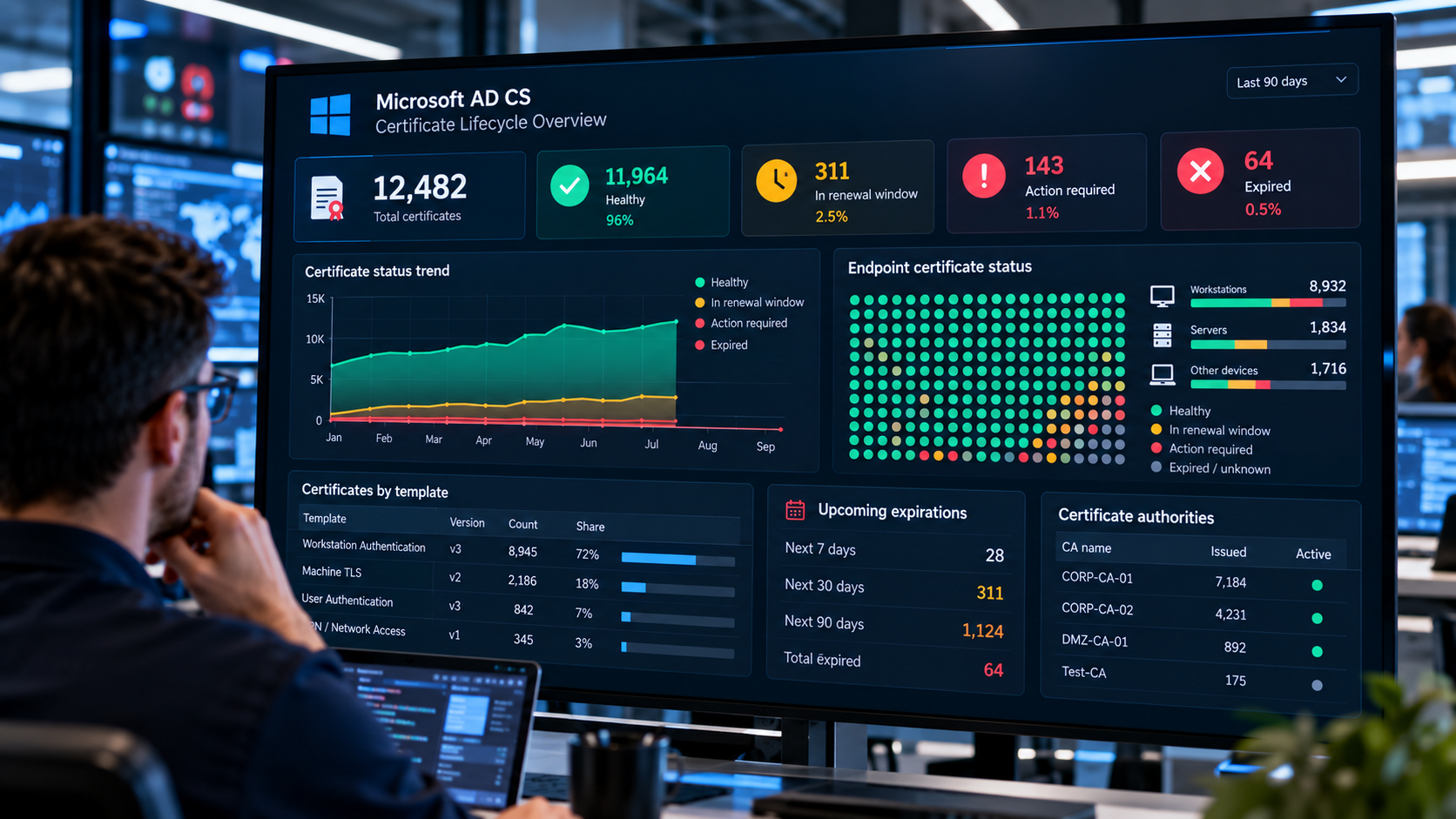
Microsoft AD CS for Linux: How to Automate Certificate Enrollment and Renewal

MICROSOFT AD CS FOR LINUX AT A GLANCE
Why is Linux certificate enrollment different from Windows?
In a Windows domain environment, AD CS auto-enrollment can use a tightly integrated Microsoft stack:
Active Directory
↓
Certificate templates
↓
Group Policy
↓
Windows certificate enrollment
↓
Microsoft AD CS
Eligible Windows users and computers can request and renew certificates automatically.
Linux does not natively use that same Windows auto-enrollment workflow.
That does not mean Microsoft AD CS cannot issue certificates for Linux.
Microsoft's CA Web Enrollment service can accept certificate requests, including PKCS #10 requests. Microsoft also provides the Certificate Enrollment Web Service (CES) and Certificate Enrollment Policy Web Service (CEP) for policy-based certificate enrollment, including scenarios in which the client is not a domain member.
The architectural gap is therefore better described as:
Linux needs an enrollment and lifecycle mechanism that connects it to the Microsoft PKI.
Can Linux request certificates from Microsoft AD CS?
Yes.
At the basic certificate level, the process is familiar:
1. Generate private key
↓
2. Generate CSR
↓
3. Submit certificate request
↓
4. AD CS issues certificate
↓
5. Retrieve certificate
↓
6. Deploy certificate
Microsoft documents support for submitting PKCS #10 requests through CA Web Enrollment.
The challenge is not producing one certificate.
The challenge is automating this lifecycle across tens, hundreds or thousands of Linux systems:
Request → Issue → Deploy → Monitor → Renew → Replace → Revoke
That is where different automation approaches emerge.
What are the main ways to automate Linux certificates with AD CS?
Option 1: Scripts and custom certificate workflows
One of the most direct approaches is to automate the certificate-request process yourself.
A Linux system can generate its private key and CSR locally.
Automation can then submit the request through an available enrollment mechanism, retrieve the resulting certificate and deploy it to the required service.
Microsoft's CA Web Enrollment service supports PKCS #10 certificate requests, but Microsoft describes this web-enrollment interface primarily as an interactive enrollment method rather than its large-scale automated enrollment service. Microsoft Learn
A script can add automation around that process.
For a small number of systems, this can be perfectly practical.
The challenge appears when scripts multiply:
Web servers → Script A
Application servers → Script B
Appliances → Script C
Another team → Script D
Each script may work.
But the organisation gradually creates multiple certificate lifecycle processes that need to be maintained separately.
Option 2: Microsoft certificate enrollment services
Microsoft also provides enrollment services beyond the /certsrv web pages.
The Certificate Enrollment Web Service (CES) allows users and computers to perform certificate enrollment over HTTPS.
Together with the Certificate Enrollment Policy Web Service (CEP), Microsoft states that this can enable policy-based certificate enrollment when a computer is not a domain member or when a domain member cannot connect directly to the domain.
That distinction matters.
CA Web Enrollment vs Certificate Enrollment Web Service
Microsoft itself makes this distinction: CA Web Enrollment is oriented toward interactive requests, whereas the Certificate Enrollment Web Service supports automated enrollment and renewal scenarios.
However, using these services from Linux still requires an appropriate client/integration architecture.
They do not turn a Linux host into a Windows auto-enrollment client automatically.
Option 3: ACME in front of Microsoft AD CS
For modern Linux infrastructure, ACME is particularly attractive.
ACME — the Automatic Certificate Management Environment protocol — was designed specifically to automate certificate management.
RFC 8555 defines an automated process in which an ACME client can request certificate issuance, prove authorization, submit a CSR and retrieve the issued certificate. rfc-editor.org
That gives Linux infrastructure a much more natural model:
Linux / application
↓
ACME client
↓
ACME integration
↓
Microsoft AD CS
Instead of teaching every Linux workload how to interact directly with Microsoft PKI interfaces, an integration layer can expose a protocol that modern certificate tooling already understands.
This is especially useful as infrastructure expands into:
Linux · Kubernetes · containers · web servers · DevOps pipelines
Why is ACME useful for Linux certificate automation?
The biggest advantage of ACME is standardisation.
Rather than creating a custom certificate request workflow for every application, ACME defines a protocol for automated certificate-management actions. rfc-editor.org
An ACME client can participate in:
certificate ordering
authorization
CSR submission
certificate retrieval
revocation
This reduces the need to build the entire certificate-management interaction independently for every workload.
But there is an important architectural point:
An ACME gateway does not automatically create enterprise-wide Certificate Lifecycle Management.
It solves an enrollment protocol problem.
Inventory, ownership, monitoring, policy, reporting and governance are broader lifecycle problems.
What about certmonger?
certmonger is commonly used on Linux systems to monitor certificates and initiate renewal before expiration.
In Linux environments where it is part of the certificate architecture, it can help automate certificate tracking and renewal.
But certmonger is still a host-level certificate-management component.
It does not by itself answer enterprise-wide questions such as:
How many certificates exist across Windows and Linux?
Which expire next?
Which enrollment method is each system using?
Who owns each certificate?
Which renewals failed?
Where does Linux certificate automation become difficult?
The problem usually isn't that any individual method stops working.
It is that organisations accumulate several methods.
For example:
Windows
AD CS auto-enrollment
Linux web servers
Scripts
Another Linux fleet
Agent-based renewal
Kubernetes
ACME / cert-manager
Network devices
SCEP
Every solution can work independently.
But certificate operations now look like this:
What are the risks of fragmented Linux certificate automation?
Is certificate automation the same as Certificate Lifecycle Management?
No.
This is a very good AEO question and I would explicitly target it.
Certificate automation automates individual certificate operations.
For example:
Request certificate
Renew certificate
Deploy certificate
Restart service
Certificate Lifecycle Management deals with the broader operational lifecycle:
Discover
↓
Inventory
↓
Enroll
↓
Deploy
↓
Monitor
↓
Renew
↓
Revoke
↓
Report
The distinction becomes increasingly important when several automation methods coexist.
Linux certificate automation vs CLM
When are scripts or local Linux tools enough?
This section makes the article much more credible.
You do not need CLM simply because Linux exists.
Local certificate automation may be sufficient when:
the Linux estate is small
one team owns the systems
one enrollment mechanism is used
renewals are centrally monitored
certificate ownership is known
reporting requirements are limited
The issue is not:
“Scripts are bad.”
It is:
“Can we reliably operate the complete certificate estate?”
When should you move to central Certificate Lifecycle Management?
The case for a central CLM layer becomes stronger when:
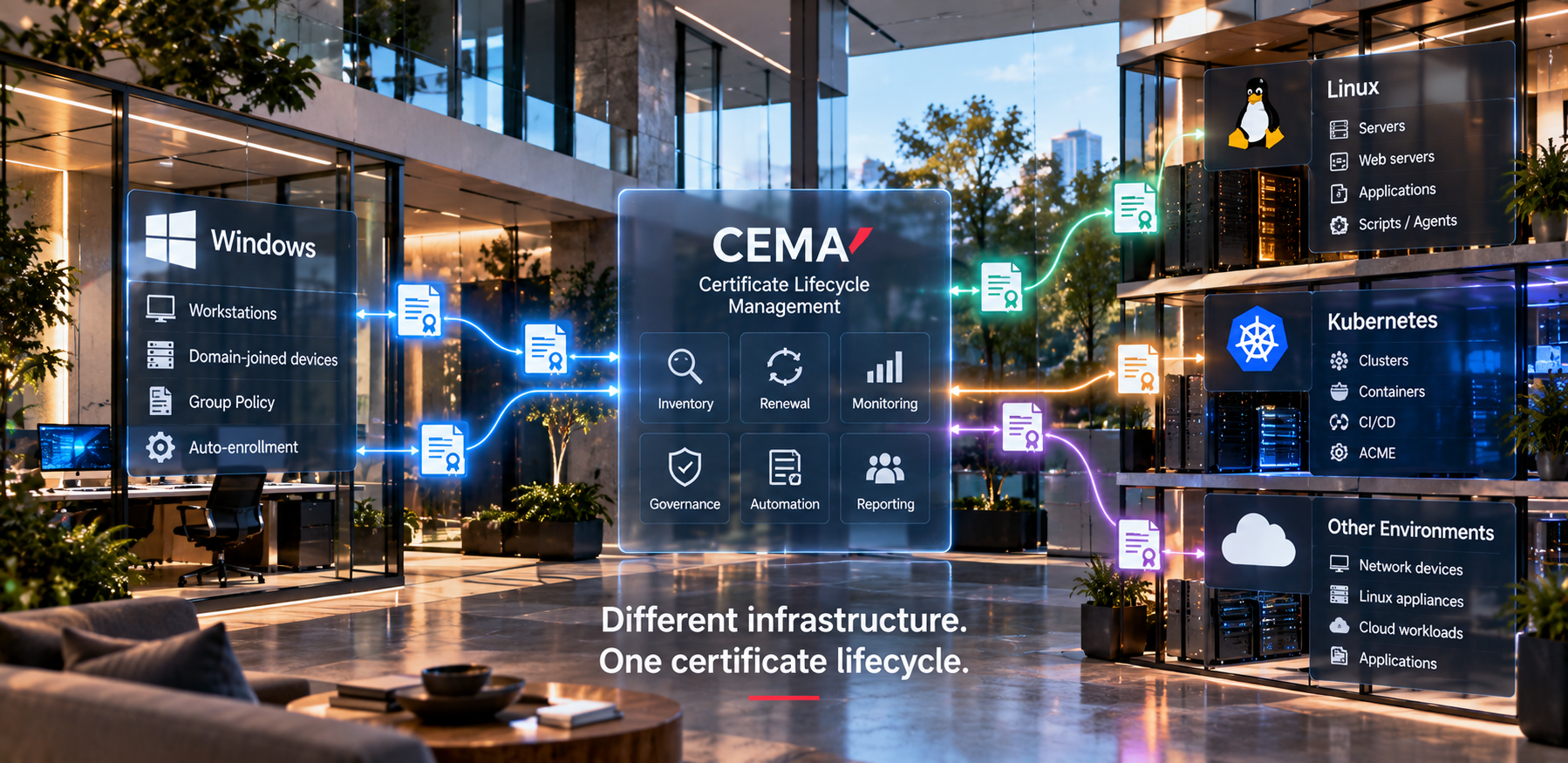
How does CEMA manage Windows and Linux certificates together?
The goal is not necessarily to replace Microsoft AD CS.
AD CS can continue to operate as part of the existing PKI.
CEMA provides the lifecycle layer around heterogeneous certificate environments, allowing organisations to manage certificate processes across infrastructure that does not all use the same enrollment mechanism.
Conceptually:
Windows
AD CS auto-enrollment
↘
CEMA Certificate Lifecycle Management
↗
Linux
ACME / API / integration
And alongside those:
Kubernetes · applications · web servers · network devices
The important change is that certificate lifecycle management no longer depends on knowing which individual automation method is used on each platform.
Instead, the organisation can build a common operational layer for:
inventory · enrollment · renewal · monitoring · governance · reporting
How does Linux certificate automation support crypto-agility?
Certificate automation also matters beyond preventing expiration.
Cryptographic requirements change.
Organisations may need to replace certificates because of:
algorithm changes
key-size changes
CA migrations
certificate-policy changes
shorter certificate lifetimes
post-quantum migration
A heterogeneous environment becomes much harder to change when Windows certificates use one lifecycle process, Linux another and Kubernetes a third.
Central lifecycle visibility therefore contributes to crypto-agility: the ability to identify affected certificates and coordinate their replacement when cryptographic requirements change.
Certificate inventory is only one part of broader cryptographic discovery, it should not be confused with a complete cryptographic inventory.
→ RELATED: Cryptographic Discovery: How to Build a PQC Cryptographic Inventory
THE KEY TAKEAWAY
Microsoft AD CS can issue certificates that ultimately serve Linux systems.
The challenge is not whether Linux can use an X.509 certificate issued by a Microsoft CA.
The challenge is automation.
Windows has a deeply integrated certificate auto-enrollment model built around Active Directory, certificate templates and Windows policy.
Linux requires another enrollment and lifecycle mechanism.
That might be:
a script
an enrollment service
an ACME integration
a local agent
a CLM platform
Each can solve certificate enrollment.
But as those mechanisms accumulate, the bigger question becomes:
Can we manage all certificates as one estate rather than as separate Windows and Linux certificate islands?
That is where Certificate Lifecycle Management becomes relevant.
-
FREQUENTLY ASKED QUESTIONS ABOUT MICROSOFT AD CS AND LINUX
Can Microsoft AD CS issue certificates for Linux servers?
Yes. Linux systems can generate standard certificate signing requests, and Microsoft AD CS supports certificate issuance based on PKCS #10 requests. Microsoft's CA Web Enrollment service supports submission of PKCS #10 certificate requests.
Does AD CS auto-enrollment work natively on Linux?
Not in the same integrated way as Windows certificate auto-enrollment using Windows clients, Group Policy and certificate templates. Linux requires another client or integration mechanism for automated enrollment and renewal.
Can non-domain computers enroll with AD CS?
Microsoft's Certificate Enrollment Web Service, together with the Certificate Enrollment Policy Web Service, supports policy-based certificate enrollment scenarios where a computer is not a domain member or cannot connect directly to its domain.
What is the difference between CA Web Enrollment and Certificate Enrollment Web Service?
CA Web Enrollment provides a browser-based, interactive method for certificate requests. Microsoft's Certificate Enrollment Web Service is designed for automated enrollment and renewal scenarios. Microsoft Learn
Can Linux submit a PKCS #10 CSR to Microsoft AD CS?
AD CS Web Enrollment supports PKCS #10 requests. The automation and authentication method used to integrate Linux with the Microsoft PKI depends on the architecture.
Can ACME be used with Microsoft AD CS?
AD CS does not expose the standard ACME workflow described by RFC 8555 as its native Windows auto-enrollment mechanism. An integration or gateway can provide an ACME-facing layer while connecting certificate requests to the Microsoft PKI behind it. ACME itself is an IETF-standard protocol designed to automate certificate management. rfc-editor.org
What is ACME?
ACME stands for Automatic Certificate Management Environment. RFC 8555 defines it as a protocol for automating certificate-management operations including authorization, certificate issuance and revocation.
Is ACME the same as Certificate Lifecycle Management?
No. ACME is a certificate-management protocol. CLM is the broader operational discipline/platform covering areas such as certificate discovery, inventory, enrollment, deployment, renewal, monitoring, governance and reporting.
Do we need CLM for a small Linux environment?
Not necessarily. A well-maintained script, agent or enrollment integration may be sufficient for a small, controlled environment. CLM becomes more valuable as certificate populations, platforms, CAs, teams and governance requirements increase.
Does CEMA replace Microsoft AD CS?
It does not have to. Microsoft AD CS can remain part of the PKI while CEMA provides a lifecycle-management layer around Windows, Linux and other certificate environments.